

Text: Jiří Král Photo: Ilja Hubálek
Few people live up to the motto “find a job you love and you will never have to work a day in your life” quite like Robert Vano. He himself admits with a laugh that when he is not shooting, he spends his spare time enlarging his photographs; when he is not enlarging them, he is framing them; and when he is not framing them, he is at least reading about them. This year he has collaborated with Blažek on a second collection, this time in the Netherlands. In the interview he reveals what surprised him most about Amsterdam, how the shoot for the second collection differed from the first, and who has inspired him most in life.
What gave you the first impulse to become a photographer?
As a child I wrote to the Baby Jesus every year about what I would like to find under the tree. He never brought me anything though, and I was left thinking I had not been good enough. Once I wrote asking for a puppet theatre, and the Baby Jesus brought me a camera. It was a kind of Bakelite Pionier – it had no aperture, no ISO, nothing. But at the time I thought it was a camera worth a million dollars.
My greatest joy the first time around was not really the photograph itself, but the fact that I had taken it myself. Everything at school back then was done as a team — all those potato-picking outings and so on. But this was something only I could do. And so I said to myself that I would like to be a photographer. The problem was that, as boys at school, we simply could not pursue certain professions. The teacher told me that photography was no profession for a man, that I could, for example, electrify railway lines. But the idea stuck with me, and in America I ended up coming back to it anyway.
Over the years you spent in Milan and New York you must have met many brilliant photographers. Who inspired you the most?
It is true that it was wonderful to live through a time when the great photographers of the First Republic were still alive. I took a great deal from my teacher Mr Horst, with whom I spent four years. He was quite strict — a German, he used only short sentences. I took one piece of advice from him that I always pass on to my own assistants: “Do you want to be a famous photographer? I will give you a good recipe. Half of success is being on time. And the other half is being born in Paris. You have neither, so try at least to be half successful.” You remember that more than you remember all the technical stuff.
The interesting thing, though, is that it was not he who inspired me. I was inspired by my generation – the hippies, psychedelia. Only later do you realise that it was merely a trend. That was a great disappointment to me, because I expected it would carry on that way. But new trends keep coming, and when a brand no longer knows what new thing to do, it does something old all over again. No one in fashion is going to introduce a style that we will still be wearing in the year 2100.
Do you look back fondly on any particular collaboration from the past?
Above all on the first ones at the beginning of my career. You are still young, you do not yet know whether you are going to be successful. There is uncertainty in it. I often think back to Milan. The agency said to me back then: “Tomorrow you are going to Milan, there is some work for you there.” I thought it would be a fortnight or so, and in the end it was four years. That was where I met all the top models of the day and where my photographs first appeared on the covers of major newspapers. I felt like a rocket. “Off I go, off I go,” I kept saying to myself, and I could feel it in my legs (laughs). The only shame was that I was there on my own and had no one to tell. You cannot truly enjoy fame if you have no one to share it with.
Do you prefer shooting for magazines, or do you enjoy campaigns more?
When I was young, my older colleagues always told me to shoot for magazines. That I had no children, no wife, no dog, no basil plant, no Porsche, no weekend cottage, nothing. That meant I did not need as much money and I had time to make a name for myself. The only way to get to the good campaigns is to be known. And people will only know you if you are published. But doing something for a magazine from time to time is important even at my age, I think — so that people keep seeing that I am still alive (laughs).
Is Blažek the first brand you have photographed?
Blažek is the first menswear brand. Earlier I shot a lot of womenswear collections for many labels.
Was photographing the second campaign for Blažek any different from the first?
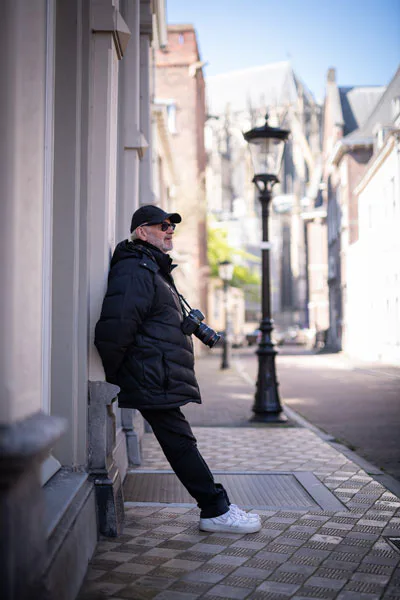
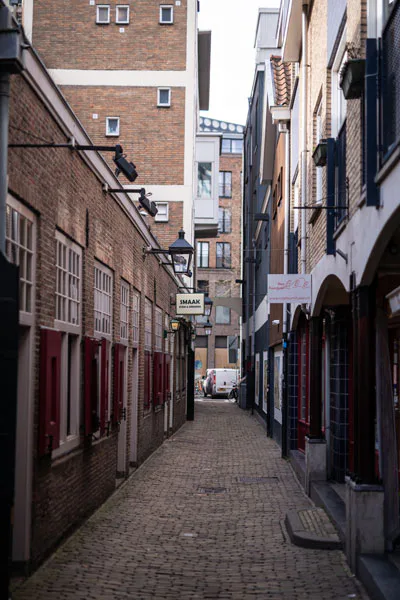
Even though I feel I photograph in the same way as always, it was certainly different. The first campaign was calmer. I suppose it was down to the location and the weather — the atmosphere in Amsterdam is simply busier. The whole city is in motion and is split into three streams – for cars, bicycles and pedestrians. The whole shoot had a different energy.
Do you prefer shooting on location, or in the warmth of the studio?
It depends on the team and the production. When the organisation is excellent, as it was on this campaign – we know when we are getting up, where we are going, we have the suits, we have the models – then shooting outdoors is wonderful. But when it is not well organised, I also like being in the studio, because I know no one can run off on me (laughs).
This was your first time in the Netherlands. Was there anything that surprised you on the visit?
What surprised me enormously was that the water in the canals was almost at the same level as the pavements. You read about sea levels rising, but standing there I thought that if they rose by just another centimetre, the whole of Amsterdam would be underwater.
Most Popular


Labels
Discussion
No discussion yet