


Have you ever wondered why there are such great differences between cotton fabrics? Why some are pleasantly smooth and soft to the touch while others are not? The reason is the process of cotton mercerisation. Let us take a look at the benefits of cotton refined in this way and of the garments made from it.
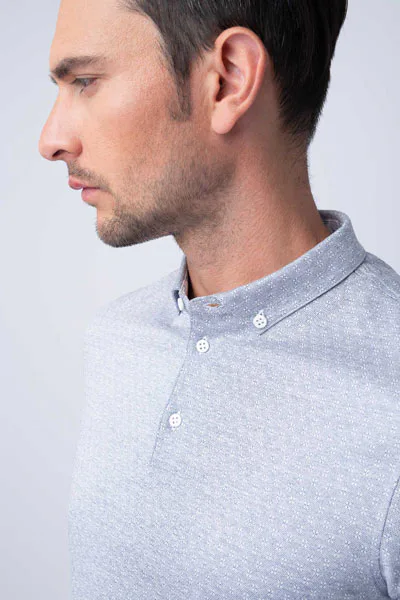
A cotton fibre refined by mercerisation is finer to the touch and visibly lustrous. The impression left by the fabric is very close to that of silk. Try touching an ordinary cotton T-shirt and a polo shirt made of mercerised cotton side by side – the difference will astonish you. And the question of which product to choose will have a very clear answer.
That, however, is not the only benefit of refined cotton. Mercerised fabrics and the garments made from them stand out for their strength and the brightness of their colours. A mercerised fibre is able to absorb considerably more water – and therefore also more dye – during the dyeing process. The difference is truly visible: mercerised cotton has colours up to 25% brighter.
Another advantage is colour-fastness, resistance to abrasion and resistance to shrinking. At the same time, mercerised cotton does not lose its natural breathability. It is therefore the obvious choice for makers of top-quality garments.
The history and process of cotton mercerisation
The origin of the mercerisation process goes back to the 19th century, when the scientist John Mercer tried soaking cotton in concentrated sodium hydroxide. The procedure has clearly defined rules. The fibre must be kept taut and is left in the solution at room temperature for about ten minutes. Wetting agents are added to the sodium hydroxide to help the lye penetrate the cotton fibres. After removal, the cotton is neutralised in an acid solution.
Only certain types of cotton are chosen for mercerisation. Because during the process cotton loses up to a quarter of its length, only long-staple varieties are mercerised – most commonly Egyptian or Icelandic cotton, or Pima.
During the mercerisation process the cotton fibres swell and change both their shape and their length. The originally kidney-shaped cross-section turns into a regular circle. Thanks to this, the cotton fabric becomes stronger, the dye is fixed inside the fibres and their surface is smoothed. These are the very properties that turn ordinary cotton into a luxurious fabric.
Garments made of mercerised cotton
Refined cotton has a very wide range of uses. Most higher-quality cotton garments are made of mercerised cotton. Men's and women's T-shirts, the ever-popular polo shirts, shirts and blouses are made from it, and so is underwear and socks. Bed linen made of mercerised cotton is also highly sought after.
Cotton with the Filo di scozia designation
This is a designation reserved for cotton fabrics of the very highest quality. The raw cotton must come from Egypt, specifically from the Giza region. The area lies along the banks of the Nile from Cairo down to the south. Only here is cotton with long, soft fibres grown. For Filo di scozia cotton a thread is used that is plied from two to three strands of fibre, each dyed and mercerised before weaving. The fibre thickness – the so-called count or titre – must not be lower than 50/2. The rule is that the higher the number, the finer and the more prized the fabric.
Once the fabric has been woven, the mercerisation process is repeated in the dye works. Thanks to the double mercerisation, the cotton fabric becomes more stable and acquires a silky sheen and a silken hand. Fabric labelled as double-mercerised has therefore undergone mercerisation of both the yarn and the woven cloth.
The excellent qualities of mercerised cotton are also used by Blažek for its own garments. You can try them on in our stores or browse the current lookbook.
Bonus of up to 10 % on your purchases
Invitations to VIP events and occasions
By registering a Blažek account you automatically receive a reward for every purchase, discounted tailoring adjustments, and you no longer need to keep paper receipts. More info >


Most Popular


Labels
Discussion
No discussion yet